7 Steps to Start Forex Trading for Beginners Without Losing Your First Deposit
You can order the same kind of articles for your own video to boost it on YouTube and Google. Just message the Telegram bot @sat_sit_bot. The bot writes and publishes the articles itself (with your YouTube video embedded) on popular topical websites (no ads). Free trial — 50 articles.
· based on the channel Jeffrey Benson Forex
Forex trading for beginners starts with three things: understanding that you trade currency pairs rather than companies, opening a demo account on a platform such as MetaTrader 5, and risking no more than 1–2% of your balance on any single trade. Everything else — strategy, sessions, psychology — is built on top of that base. The full walkthrough below follows the structure of the beginner course published by Jeffrey Benson Forex, and students who want the author's structured programme can find it at the Fire Pips FX plans page.
What forex trading actually is and why currencies move
Forex is the market where one currency is priced in another, which is why every quote comes as a pair: EUR/USD at 1.0850 means one euro buys 1.0850 US dollars. There is no central exchange — trades are executed over the counter through a network of banks, brokers and liquidity providers, and the market runs continuously from Sunday evening to Friday evening (UTC) as sessions roll from Asia to Europe to the Americas.
Prices move because of supply and demand driven by interest rates, inflation data, central-bank decisions, employment reports and geopolitical news. A currency strengthens when capital flows toward it, usually because yields there are attractive or the economy looks stable. Beginners do not need to forecast economies; they need to recognise when a pair is trending, ranging or reacting to a scheduled news release.
The four sessions matter for a practical reason: liquidity. Sydney and Tokyo are quieter, London brings the largest volume, and the London–New York overlap is where spreads are tightest and moves are cleanest. Trading a quiet Asian session with a strategy built for London is one of the fastest ways to collect losses.
The tools every beginner needs before the first trade
A working setup is smaller than most people expect, and it costs nothing to assemble. Build it in this order:
- A demo account with a broker, funded with virtual capital that mirrors a realistic balance — 1,000 to 5,000 units is enough to practise position sizing.
- A trading platform. MetaTrader 5 (MT5) is the most common choice for execution and is what most signal-following workflows assume; TradingView is popular for charting and drawing levels.
- A broker with real regulation. Check that the entity holding your money is licensed by a recognised authority and that client funds are segregated. Spreads, commissions, swap rates and withdrawal terms matter more than bonus offers.
- A notebook or trading journal. Recording entry, exit, reason and outcome for every trade is the only reliable way to find out whether a strategy works for you.
- An economic calendar so you know when inflation, payrolls or rate decisions land — and can stay out of the market if your plan does not trade news.
A common beginner question is whether a mobile phone is enough. It is enough to watch charts and place simple orders, but anything involving multiple timeframes or precise stop placement is far easier on a desktop screen.
A basic strategy foundation you can test on a demo
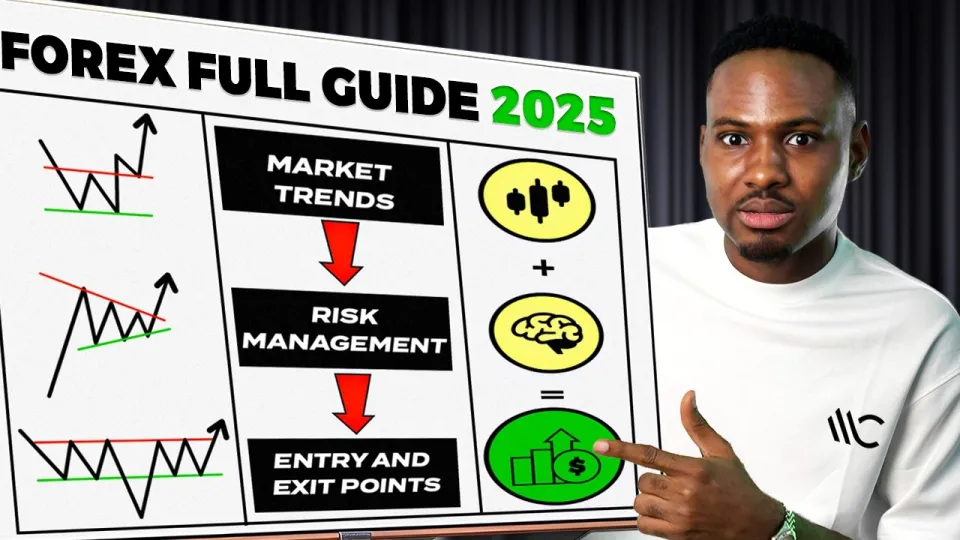
A beginner strategy does not need to be clever; it needs to be repeatable. The workable template is trend plus level plus trigger. First, identify direction on a higher timeframe — if price is making higher highs and higher lows on the daily chart, you look for longs. Second, mark the horizontal levels where price has repeatedly turned: prior highs and lows, round numbers, and the highs and lows of the previous day. Third, wait for a trigger on a lower timeframe, such as a break and retest of a level or a rejection candle at it.
Two rules turn that template into a system. The first is a fixed risk per trade of 1–2% of equity, which means position size is calculated from the stop distance, not guessed. The second is a defined reward-to-risk ratio — 1:2 is a reasonable starting point, so a 20-pip stop targets 40 pips. With 1% risk, ten consecutive losses cost about 10% of the account, which is survivable; with 10% risk, ten losses are close to ruin.
Beginners should also pick one or two pairs and one session and stay there for at least a month. EUR/USD and GBP/USD are liquid and well behaved during London hours; exotic pairs have wide spreads and erratic moves that punish inexperience.
Placing your first trade step by step
Execution is mechanical once the plan exists. On a demo account: confirm the higher-timeframe direction, mark the level, wait for the trigger, then calculate lot size from the stop distance and your 1% risk. Enter the order, set the stop-loss and take-profit in the same ticket, and write the trade in the journal before walking away.
Platform mechanics are simple: a buy order profits if the pair rises, a sell order profits if it falls, and the difference between bid and ask (the spread) is a cost paid on entry. Leverage multiplies exposure, not edge — a 1:100 account does not make a bad setup good, it only makes the loss arrive faster. New traders should keep leverage low in practice even when the broker offers far more.
Run at least 30–50 demo trades with the same rules before risking real money. If the journal shows a positive expectancy and you can follow the rules without improvising, move to a small live account — the psychology changes the moment real money is on the line.
Mistakes that cost beginners the most money
The most expensive beginner error is trading without a stop-loss, or moving it further away to avoid being stopped out. A stop is the price of being wrong, and it must be set before entry. The second is oversizing: risking 10–20% per trade turns three bad days into an account wipeout.
The third is revenge trading after a loss — doubling size to win it back, which converts a small drawdown into a large one. The fourth is strategy hopping: switching systems every few days means no method ever accumulates enough data to be judged. The fifth is treating a signal channel as a substitute for understanding; copying entries without knowing the stop and target leaves you unable to manage the trade when the provider is asleep.
Finally, be sceptical of anything promising guaranteed returns or asking you to fund an account through an unregulated intermediary. Verify the broker's licence independently before depositing.
Questions beginners keep asking
Many viewers arrive worried that forex is too complicated or a scam. The honest answer is that the mechanics are simple and the discipline is hard: a beginner can learn to read a chart in weeks, but consistent execution takes months of journalling. Others ask whether they can start with 50 dollars — technically yes, but tiny accounts make proper position sizing impossible on most pairs, so demo practice first is the better path.
A frequent theme is impatience: people want a timeframe for becoming profitable. There is no fixed number, but 30–50 logged demo trades and a full quarter of disciplined live trading is a more realistic benchmark than a weekend. Another recurring question is whether to follow signals while learning; it can help with exposure, but only alongside your own journal and risk rules, never instead of them.
Useful links from the course
- Fire Pips FX plans and student programme
- Free daily signal channel: https://t.me/firepipsignals
- Broker registration used in the course: https://my.assexmarkets.com/auth/register?partner_code=1699134
- Premium signal group access: https://t.me/jeffreybenzhelpbot
Final thoughts
Forex rewards process over prediction: a defined setup, 1–2% risk, a stop-loss on every trade and a journal you actually fill in will outperform any clever indicator. Start on demo, prove the rules over dozens of trades, then scale slowly with money you can afford to lose. The beginner course from the Jeffrey Benson Forex channel is a useful spine for that process because it moves in order — market basics, tools, strategy, first trade, mistakes — rather than jumping to setups. If you want the structured version with the author's own material, start at the Fire Pips FX plans page and keep the free signal channel as a reference, not a crutch.
Key takeaways
- Forex is an over-the-counter market where currencies are quoted in pairs such as EUR/USD; there is no central exchange and trading runs 24 hours a day, five days a week.
- Four sessions — Sydney, Tokyo, London and New York — drive liquidity; the London–New York overlap is the busiest window of the day.
- A beginner needs three things: a demo account, a charting platform such as MetaTrader 5 or TradingView, and a broker regulated in a recognised jurisdiction.
- Risk per trade should stay at 1–2% of account equity, and a stop-loss is set before the entry, not after it.
- Jeffrey Benson Forex structures its beginner course around market basics, tools, strategy, the first trade and common mistakes.
Questions & answers
How much money do I need to start forex trading?
You can open a live account with a few hundred dollars at many brokers, but a realistic starting balance is one where 1% risk still allows a sensible position size — often 500–1,000 dollars or more. Most beginners should spend the first weeks on a demo account, where capital is virtual and mistakes are free.
Is forex trading suitable for complete beginners?
Yes, the mechanics are learnable in weeks: pairs, sessions, orders, stops and position sizing. What takes longer is discipline — following the same rules through losing streaks. Treat it as a skill with a training period rather than a shortcut to income.
How long does it take to become profitable?
There is no fixed timeline, but a reasonable benchmark is 30–50 journalled demo trades followed by at least a quarter of consistent live trading with small size. Profitability usually shows up as a stable process in your journal before it shows up in your balance.
Can I just copy signals instead of learning to trade?
Signals can give you market exposure while you study, but copying entries without understanding the stop, target and risk per trade leaves you unable to manage the position. Use them alongside your own journal and a 1–2% risk limit, never as a replacement for the basics.
Source: How To Start Forex Trading For Beginners’ 2025 (Full Course) · Markdown version